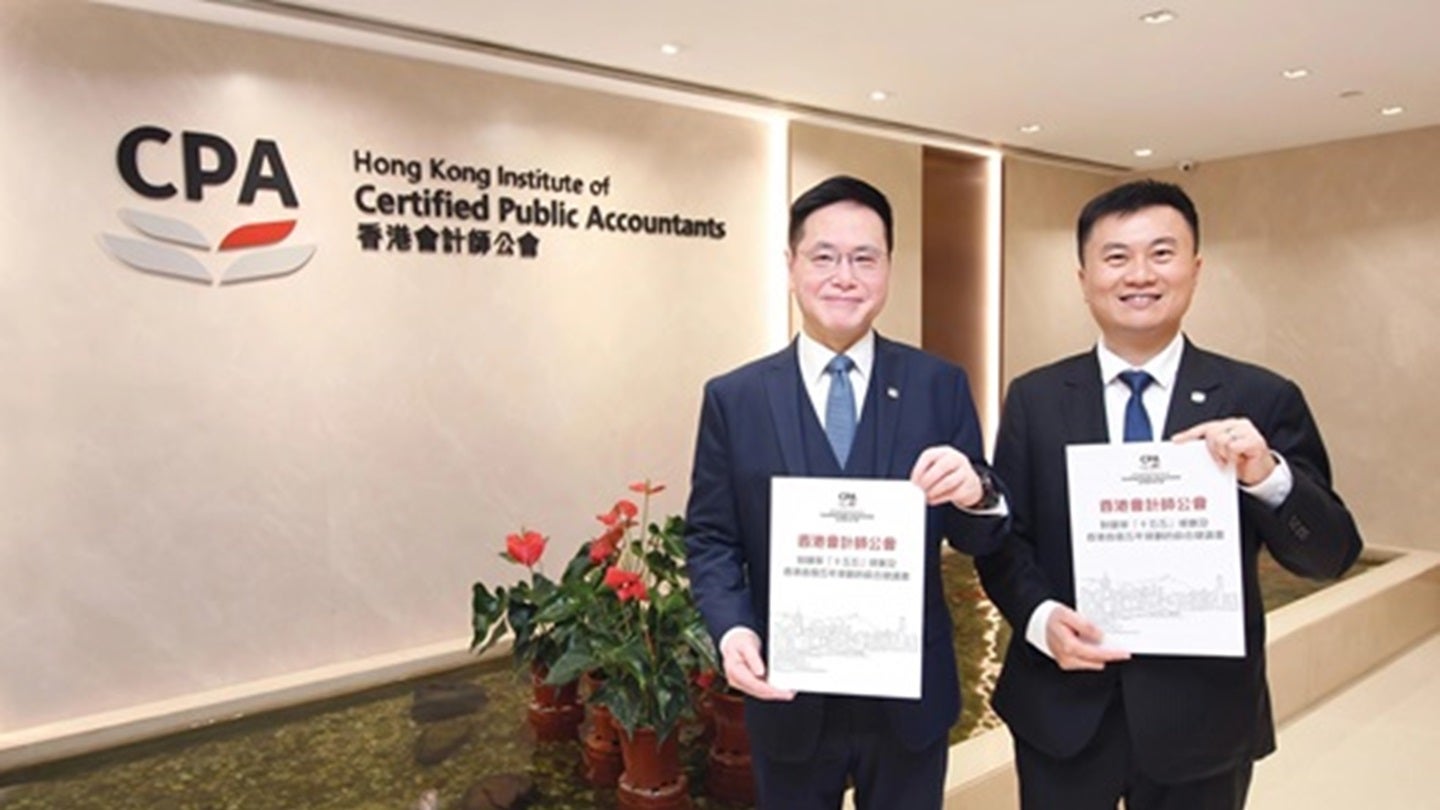
The Hong Kong Institute of Certified Public Accountants (HKICPA) has set out seven policy recommendations in its submission to the public consultation on Hong Kong’s first five-year plan for economic and social development.
It said the proposals are designed to support Hong Kong’s alignment with the National 15th Five-Year Plan while reinforcing the city’s professional services sector.
Go deeper with GlobalData


Access deeper industry intelligence
Experience unmatched clarity with a single platform that combines unique data, AI, and human expertise.
The institute’s submission covers green development and sustainable finance; talent, professional qualifications and education; reform of the business environment; Hong Kong’s role as an international financial centre; the establishment of a “Hong Kong Accounting Park”; tax policy and wider opening up under CEPA; and social and financial inclusion.
On green finance, HKICPA said Hong Kong Standard on Sustainability Assurance 5000 (HKSSA 5000) should underpin the development of sustainability assurance in Hong Kong.
It also called for faster progress on carbon credit trading and accreditation.
As part of this, the institute proposed that Hong Kong Exchanges and Clearing Limited establish a dedicated carbon credit trading segment linked to the Mainland carbon market and aligned with international standards.
In talent and education, HKICPA proposed a licensing regime for valuation professionals to support intellectual property and innovation and technology enterprises.
It also suggested making valuation a specialist area within the professional accountancy qualification framework, together with a dedicated module on intellectual property valuation.
Further proposals included professional certificate programmes, progression pathways to master’s degree courses with local and overseas universities, and cross-boundary internships.
The institute also said university accounting and finance degrees should be updated to include digital tools, global regulatory developments, environmental, social and governance, and green finance.
On business environment reform, HKICPA recommended considering a reasonable cap on accountants’ civil liability.
It also proposed changes to professional indemnity insurance and liability allocation mechanisms.
Separately, the institute urged faster legislation for a corporate rescue regime and a provisional supervision mechanism to help reduce the risk of disorderly liquidation.
Other recommendations included refining tax arrangements for corporate treasury centres and improving fundraising mechanisms for red-chip and H-share companies.
HKICPA also proposed establishing a “Hong Kong Accounting Park” in the Northern Metropolis.
In addition, it called for broader access for Hong Kong accounting, auditing and taxation services under CEPA.
The submission also included measures aimed at strengthening financial management support within poverty alleviation and wider social support policies.
HKICPA president and member of the National Committee of Chinese People’s Political Consultative Conference (CPPCC) Stephen Lawsaid: “The accounting profession in Hong Kong stands fully prepared to leverage its expertise in financial reporting, auditing and assurance, taxation, corporate governance, risk management, and sustainability to support Hong Kong maintain and further strengthen its position as a leading international financial centre.”