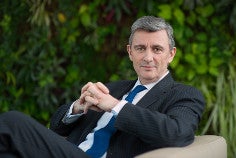
As the French professional body (OEC – Ordre des Experts-Comptables) congress drew to a close and the room was being cleared, its president Philippe Arraou sat down with Vincent Huck to talk about the congress and the challenges ahead for the French accountancy profession
The Accountant: I think there was a bit of hiccup at the end of the congress in terms of numbers, you announced 5,000 delegates during the opening ceremony, but the closing video referenced 4,000.
Philippe Arraou: Yes that was a mistake. We did have 5,000 delegates: 3,400 French and 1,600 Belgian.
I was expecting fewer Belgians and more French, but the terrorism risks affected the event. Today, to organise an event with a large audience isn’t easy, and on top of that, in Brussels! The reason I say that is because I received a lot of feedback from colleagues on this, saying I was crazy and that they wouldn’t come.

Access deeper industry intelligence
Experience unmatched clarity with a single platform that combines unique data, AI, and human expertise.
I had already received the same kind of feedback when we first floated the idea of doing the congress in Brussels. And even some Belgian professionals had this reaction. That’s why 5,000 people in that context is a great achievement.
If it had been a year ago, before the terrorist attacks in Paris and Brussels, I believe we would have had more than 6,000, maybe 7,000. I’m very happy, because it’s not only about going to Brussels, it’s about moving outside the French border for a profession that’s very traditional and conservative. It’s a first.
Beyond the security risks, at the moment Europe is not very popular, and it’s not necessarily attractive to go to Brussels. There is a citizen demarche in this congress: it is professionals going to Brussels to say we are making proposals. It’s also a European demarche. If I wasn’t myself a European and if I didn’t believe in the European Union project I wouldn’t have launched the idea.
It all goes against the current mood and that’s why I’m happy with the results and the response.
The Accountant: Even so, is there a bit of a frustration – maybe that’s a strong word – a little sadness that more French professionals didn’t answer that European call?
Arraou: In 2016, in the context of Brexit, and the image of the EU, it wasn’t possible. I’m sorry that there weren’t more. But last year, in Paris, we were at 6,000. In 2012, also in Paris, we were 4,800. In 2014 we were 4,500, but in 2013 we were 3,200. So this year is not bad.
The Accountant: Two years ago you told me that the French profession was a bit late on globalisation and a little reluctant to go onto the international stage. Are you seeing a beginning of an evolution two years later?
Arraou: I think that in my two-year term as president I will certainly have impacted the profession. I think I have brought this international dimension. For example, for two years in a row we had the president of IFAC Olivia Kirtley coming to our congress. That’s a first.
The Accountant: But speaking of the professionals themselves, do you see an evolution?
Arraou: It’s quite a long process which needs time. I think they understand that regulations and standards come from outside our borders. It’s a reality. When you look at their work and their client mandates, there’s still a way to go.
The Accountant: One of the themes of the congress was tax. There was a lot of bad press in the past year for the profession, at least in the UK and the USA, was it the same in France?
Arraou: It depends who we talk about in the profession, and I’m not being mean and not pointing the finger at anyone in particular. Those who received this bad press I believe are the same in France and in the UK or elsewhere. It’s the large international structure, the big networks which help to optimise their clients’ tax – I’m using flattering language.
Those in France in the spotlight are accused of participating in tax avoidance and organising it. The firms that were questioned by the European Parliament Special Committee on Tax Rulings chaired by Alain Lamassoure were highly criticised.
The Accountant: At the start of the congress you presented tax-related proposals to the commissioner. It’s interesting to see professionals opening up a debate with politicians, but shouldn’t professionals also speak to public opinion? Not many people actually know what a tax advisor does, and how he/she advises clients. As you said, there’s this idea that the tax advisor is one of the architects of tax avoidance. Shouldn’t then professionals, and in particular the French profession, explain better what it actually does?
Arraou: The answer is in the organisation of this congress. I say to my colleagues the objective of all this is to talk about tax, and especially to have accountants, professionals, talk about tax. It’s a way of saying we are here, this is our topic. And yes, there is a lack of communication on the part of the professionals, and there’s a lack of understanding from public opinion on what an accountant does, not only in tax but in other services as well. So that was clearly one of the objectives of this congress for me.
The Accountant: I spoke with a delegate who was fed up with Commissioner Moscovici’s speech, and he was accusing journalists of repeating everything politicians say. I opposed him on that saying I was here with a microphone and ready to hear his version. He said he wouldn’t because there’s a form of fear of talking to the media. Do you understand what he means?
Arraou: It’s more a lack of confidence. And it also depends on people. When I became president I didn’t know much about the logistics behind the role. When came in, I asked who was our PR agency and who was in charge of communication internally? I got a quick answer: there was no one, because the former president didn’t want to speak with journalists because he didn’t want to be tricked. So it’s a personal thing. Some people are more comfortable in communicating, and as journalists are professional communicators some people might get cold feet; that’s how I see it.
The Accountant: In your final speech, you mentioned the proposals made to the commissioner and that they were made to say “enough is enough”, what did you mean by that?
Arraou: What is enough is the lack of tax convergence in Europe. The current situation can’t go on. If not harmonisation, at least convergence is necessary to put an end to this competition between states which belong to a single market. There is an incoherence here. Is it a single market or it isn’t it? If it is, then there should be more or less the same rules.
And on top of that, digitalisation brings about a new economy which is completely free of tax because it doesn’t meet the criteria to fit in the current tax frameworks. So there’s tax injustice. We’re moving towards more digitalisation and the economy as a whole needs to adapt. But at the moment digital companies compete with traditional businesses which pay their taxes.
The schemes used to reduce tax allow companies to reduce their prices, so really the competition is unjust. For example, look at Amazon in France, besides my function as the president of the institute I still have a small firm in a rural area and I see the impact of Amazon with a lot of bookshops closing. But it doesn’t stop there: the bookshops close, so people lose their jobs and claim benefits while there’s less tax income for the state.
The Accountant: Two year as president, five months to go, you mentioned some successes in your speech especially in terms of changes in the law.
Arraou: Yes, the Macron law is an incredible change, because it allows us to have advising as a main service line. It’s a great evolution for the profession, which really has been asked for and pushed for by us, and which follows the evolution of the economy towards digitalisation. It comes at a time when we will have less work in the traditional service lines because of digitalisation and automation. So it’s important that professional accountants can service businesses even if it is not in pure accounting.
The Accountant: I was really surprised when you mentioned that in your speech because for the past three days I’ve been asking all the delegates I met without exception if that particular law had any impact on their activity. And everyone said, no, none whatsoever.
Arraou: First, the Macron law is an incredible melting pot. There’s a lot in there, and only two articles that touch on the accountancy profession, so they went unnoticed. Nobody talk about it.
Second, it’s the role of the institute to inform the professionals. On 22 June we organised the day of advisory and we presented the law and what it meant for professionals – what they could now do. To my great surprise, on 22 June people were discovering the law when it dates back to 6 August 2015! It really showed us the degree of knowledge from the professionals, but also it gave us an understanding of our role to inform the profession – it shouldn’t be, but that’s the case.
We, as an institute, started with a regalian role to oversee an activity and control the deontology of the profession. But more and more it’s about helping firms and professionals.
The Accountant: In your speech you mentioned the possibility convergence of the OEC and the CNCC, there was a presentation by FIDEF as part of the congress programme on should the francophone profession….
Arraou: They are proposing to open up membership of the institutes beyond the chartered accountants. Yes – why not? Because if you look at the number of members in sub-Saharan Africa it’s around 100-120 which is not enough considering the size of the economy of the countries. In parallel the idea is to help some of the firms and professional which are at the border between legality and illegality to evolve in respect to rules and standards, which is very much linked to the informal economy.
The Accountant: Would there be any interest in opening the membership beyond the chartered accountants in France?
Arraou: No, there’s no demand or need. Businesses are serviced, it’s not a topic. But my comment with regards to the two French institutes was different and referred to the fact that in France we have two institutes, the OEC and the CNCC, which cater for two types of activities but the same professionals. And if you compare that to what’s done in other countries, it’s a bit surprising.
The Accountant: You would be in favour of merging them but with one objection…
Arraou: I’m in favour of getting the two closer, but it can’t be an acquisition of one by the other.
And I wanted to say it, as the president of the OEC, because the OEC is stronger than the CNCC. Our budget and staff are nearly double. So the balance of power is in favour of the OEC, and when we talk of merger we all know that there’s no merger of two equals and one takes over the other. So a short-sighted vision would be to think that the OEC would take over the CNCC. But I say no because it’s not acceptable for auditors and I believe we can do it differently.
The Accountant: If you could do another two years as president what would you like to focus on, or what would you suggest your successor focuses on?
Arraou: For me it’s the transition of the firms towards digital. I started a lot of activities around this and there’s a lot more to be done for a while. And what the institute really should do is help the firms in their evolution. It’s our responsibility. Small businesses should be reassured today. And I told the CEO of CEGID, that it’s incredible that some SMPs are not using the cloud. But it’s a psychological hurdle. And on top of that, SMPs feel very small when talking to people like SAGE so there’s also a role here for the institute for a collective representation to help them negotiate.
The Accountant: Thanks for your time.
Arraou: Let see if with this you can paint a picture of the French profession without giving it too much of an outdated look.