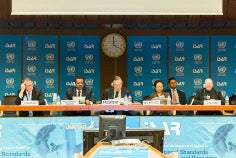
The latest United Nations Intergovernmental Working Group on Accounting and Reporting Standards (ISAR) serviced by the UN Conference on Trade and Development (UNCTAD) took place in October 2016 and was the 33rd of its name (ISAR33). On the agenda were the following two main topics:
• Practical implementation of compliance monitoring and the enforcement of accounting and audit requirements for high-quality reporting;

Access deeper industry intelligence
Experience unmatched clarity with a single platform that combines unique data, AI, and human expertise.
• Enhancing the role of reporting in attaining the sustainable development goals: integration of environmental, social and governance information into company reporting.
Similar to previous years’s format, ISAR33 saw a long list of speakers from a variety of organisation, such as, but not limited to: the International Federation of Accountants (IFAC), the World Bank, the International Accounting Standards Board (IASB),the Global Reporting Initiative, the European Financial Reporting Advisory Group (EFRAG), the Financial Reporting Council of Nigeria, the International Auditing and Assurance Standards Board (IAASB), the International Integrated Reporting Council (IIRC) and more.
Each speaker had a 15-minute slot to present their organisation’s work in the remit of financial reporting. Sessions were followed by questions and answers with the UNCTAD/ISAR delegates. Here are the highlights from those Q&A sessions.
Kurt Ramin (Germany) (addressing IFAC president Olivia Kirtley): Since you’re from the USA, you’ll be familiar with the Fortune 500. The largest 500 companies had revenues of $27trn and made profits of $1.5trn last year. They employed 67 million people globally. These companies are leaders in compliance systems, in accounting and other related subjects, which are the focus of our discussion here. So my question is how can we, from an accounting standpoint, use these global leaders’ companies in our efforts to build more accounting capacity and use the management accountants in these companies towards the goals of the sustainable development goals?
Olivia Kirtley, president, IFAC: It’s a great point. A great question, and I think you’re absolutely right. I happen to be a non-executive director of some of these large companies, so I’ll speak from that viewpoint in addition to from the accounting profession. I think there is work going in that regard. I think direct engagement with the leadership of these companies is what we need to do. It’s all about culture tone at the top and what they will personally champion and lead. I think they are focused, in the countries that they’re in, on this capacity building and bringing their systems, etc. But I think it could be done more broadly and so there needs to be more effort in engaging the management teams and the leadership of these large companies in these efforts, rather than leaving it more at the operational level.
Delegate from Nigeria: My question goes to Nicolas Bernier. During his presentation, he said the European Union organisations with 500 and more employees will be expected to disclose environmental and social information as part of their sustainability reporting. Don’t you think the threshold of 500 employees is too high? Will that encourage voluntary or optional compliance for organisations that have fewer employees? In our opinion, there are more organisations that will fall outside the threshold which I think should be accommodated.
Nicolas Bernier, policy officer at the European Commission in DG Financial Stability, Financial Services and Capital Markets Union: When the decision for the adoption of this European legislation on disclosure of non-financial information was taken two years ago, we wanted to put forward two ideas. On the one side, disclosing relevant financial and environmental information, information related to human rights, to corruption, anti-corruption and bribery, and other aspects of information that cannot be classified and cannot be understood as financial information, is part of the core of the management report. It’s an exercise of transparency that companies need to make, and certainly need to make in the European Union.
And we realised, although many companies are making a very significant effort in the European Union in the area of non-financial reporting, that was not enough. It was understood, it was assessed at the time, that around 2,000 to 2,500 companies in Europe were disclosing this information on a regular basis. In the European Union, we have something like 30 million companies in total, of all sizes. So we thought that something had to be done, that legislation was necessary to make this step forward on transparency.
So we made non-financial reporting a requirement together with financial reporting. On the other side, we wanted to avoid undue administrative burden. And there was a specific concern for smaller companies. So we took a decision on a threshold of 500 employees, which is higher than the normal threshold that we use for large companies. Typically, European legislation referring to large companies refers to a threshold of 250 employees, with another two thresholds on turnover on the size of the balance sheet. But we wanted to make clear, at that point in time, that we didn’t think smaller companies require legislation to disclose non-financial information.
Nevertheless, smaller companies in the European Union can do it out of their own initiative or by effect of national legislation, including the management reports on non-financial information. That is something that a number of smaller companies already do. National legislation in a number of member states in the European Union also requires that disclosure. They will be a clear and a very determined legal requirement for larger companies and a sort of a promotion and incentivisation of transparency for smaller companies.
Jim Obazee, CEO, Financial Reporting Council of Nigeria: I have a question for Jarett Decker of the World Bank, I want to know whether you have been able to engage policymakers in both the areas of capacity and incentives, especially as you carry out impact assessments on your report on standards and codes in accounting and auditing. If you engage policymakers in this area, can you share your insights? We’d be interested in knowing their thoughts.
I also have a question for Philippe Danjou at IASB. I’m actually very worried about the fact that the IASB has decided to concentrate on financial reporting issues and not devote resources to non-financial reporting. That’s one problem. A second problem is the fact that the IASB in its five-year agenda, is also not thinking of the financial reporting by non-for-profit organisations. You said you’ll be monitoring it from afar. Who, in your view, should focus on non-financial reporting and not-for-profit organisations’ financial reporting issues? Because the IASB has moved to a certain stage, the global community is beginning to look up to IASB to deliver on these.
Jarrett Decker, head of the World Bank’s Centre for Financial Reporting Reform: As I understood the question, it is: have we engaged policymakers on this question of attempting not only to improve capacity, but to create incentives for reliable reporting, in both the financial and non-financial sphere? And the answer is yes. We’ve done it in several different ways.
In the reports that the bank performs, we perform regular assessments in different countries. They’re called the Reports on Observance of Standards and Codes, the ROSCs. And one issue that has become more prominent in our ROSC reports is exactly this question of incentives: will the people who are actually reporting have the motivation to care about it, to invest in it, and to report reliably?
So it’s an issue that we raise in formal reports and it’s also an issue that we have raised directly with policymakers, and it comes up in several different ways. I think one basic way that it comes up is that we talk a lot about cultures of compliance and cultures of non-compliance. If you want to have businesses to have incentives to report reliably, and to adhere to the formal standards that have been adopted, we have learned that the very first thing that has to happen is that the standards have to be realistic.
And in too many of the countries, we have seen things happen like IFRS being adopted for all entities of all sizes. We see that in some of our client countries. Or even IFS, IFRS for SMEs, which are certainly simplified, but if those are applied to too small companies with a capacity too low, compliance is really not possible. IFRS for SMEs is a very sophisticated standard. It’s an abbreviated standard, but it’s still very sophisticated.
So I think the first thing in engaging with policymakers that we try to do is make sure, first of all, that the framework is realistic for the entities that will do the reporting. Another thing that we’ve tried to do is link together the stakeholders of financial reporting in the countries where we operate. So we try to get the banks to talk to the ministries of finance and to the other regulatory agencies to let them know what they want: what would banks need to see and what kind of assurance would they need to have in order to be able to lend based on something other than triple collateral?
Banks in many of our client countries will only lend to small and medium-sized enterprises based on very heavy amounts of collateralisation, and that’s a big problem. So we go to the banks and we try to get the banks and government officials and standard-setters together and ask what they would need to see? What would you need to do to have confidence to actually lend based on reported cash flows of these small and medium-sized enterprises? What would you need to know to lend based other than on a purely collateral basis?
So that’s another area where we try to engage policymakers, but it’s also an area where we try to engage with the local accounting practices. One area of increasing involvement for us is trying to help build the capacity of small and medium-sized accounting practices to provide broader services than compliance to their clients, to become business advisors to their clients and to help their clients grow and prosper. And that is also part of, I think, the policy response, creating that environment that will enable companies to see the accounting function as something more than just obeying the law, something that will help them get access to credit, to improve the discipline of their systems, to lose less through waste and otherwise to run more efficient and effective businesses.
Philippe Danjou, IASB member*: I think it was an assertion more than a question. You have a lot of confidence placed on IASB, which in your view, could be able to develop some guidance or standards in the field of non-financial reporting or could address reporting needs of not-for-profit organisations. And so I want to thank you for the confidence you expressed in our capacity.
However, the point that you also mentioned, engaging with constituents and engaging with policymakers, is an important matter. And our trustees who preside over the destiny and the mission of the IFRS foundation do that a lot. They engage every five years with a review of the constitution, the mission, and the strategy of the organisation. And each time, the response by constituents and policymakers has been clear. It is not the priority role of the IFRS Foundation and the IASB to deliver standards in the fields outside of financial reporting.
It is not the priority role of the foundation to develop guidance for not-for-profits. Our aim is to develop standards for the for-profit commercial sector, listed companies and SMEs.
Now, the question is why did the respondents tell us to stay focused on what we do currently? There are two reasons. You think we are competent to do those kinds of things. I’m not sure, as a board member, that I am competent to develop guidance on non-financial reporting. Most of us on the board have professional experience in financial reporting, auditing, preparation of financial statements, regulating markets, but financial markets. We have very little experience in non-financial reporting. If we were to develop activities in that field, we would need to transform the organisation fundamentally, and we don’t have the resources at the moment to do so. We have not been given funding for an aim other than developing guidance on financial reporting. People fund us. We are a private organisation. Keep that in mind. We are financed by our constituents. They would be quite unhappy if we were to decide to spend their money on something else.
Also I’m not sure that the policymakers, like the European Parliament, would be happy if we were to start developing guidance in an area where we have not been recognised by the European institutions. We’ve been recognised to develop standards for financial reporting on behalf of the European Commission in a way. I don’t think the European Commission or the Parliament would be too happy if we were to adopt the
activities of a different field. I’m not sure the funding by the European Commission would be maintained if were to spend money on something else.
So there are many constraints, both in terms of capacities and resources. This is not to say there is no need. I think you rightly pointed out the need for some form of standardised information by not-for-profit organisations.
Maybe at some point in the future, once we are finished dealing with financial reporting by for-profit, we could move to not-for-profit, but it would need to change the organisation quite a lot.
Delegate from Cote D’Ivoire: we are in a dead end because there is a conflict of interest, on one side the standard-setters (IFAC and IASB) and on the other side investors and public powers. All the speakers this morning asked somehow UNCTAD to take its responsibility. Investors might not want to publish this information because it doesn’t fit their profits-driven initiative, so what can UNCTAD do? Shouldn’t UNCTAD support standard-setters and local regulators to mandate the publication of non-financial information?
Danjou: From the IASB’s view, the idea is not to undervalue in any way the importance of these environmental risks and the role they play. When these risks are made material, when they can be numbered in some way, then of course it falls to the standards: costs of dismantling and all obligations that exist relating to past events and what can happen in the future. But it’s possible to make this numerically understandable.
Now, when we’re talking about risks that are potential, in the future, which no doubt will take place, but they’re not yet totally understood. These are not risks that can be set down, black and white, in an account. Of course, we do have to talk about them. We have to raise these matters. Management has to speak about this. They have to communicate.
But we’re going beyond the purview of the financiers. When it comes to financial balance sheets and accountability beyond our realm, this is a matter of demarcation lines, but it’s nevertheless very important. We must not overlook these matters, which is why we absolutely support all the initiatives aimed at speaking better, and more, about these risks that will occur tomorrow that we will have to account for, so that the decision-makers are not taken by surprise by this. Because by the time they are able to be covered in our accounts, it can be too late. So we have to do this before the financial consequences take.
Gerard Ee, president of the institute of Singapore Chartered Accountant and chairman of ISAR33: The fact that we are meeting here and we have a nice experience from different stakeholders exactly addresses your point that UNCTAD actually is concerned and is addressing the issues by hearing everyone’s view and bringing it all together, and eventually there will be harmonisation of views and something will be done on an international basis. So not to worry. It’s a journey. It takes time.
Delegate from India: Gerard, you spoke about multinational accounting firms or group network audits to be done. You know that most of the global networks of firms don’t really have an ownership structure per se. The benefit of this global network brand is available to the entity operating in that jurisdiction. So, what models do you see regulating these global networks without an ownership structure? For example, if we have an audit firm in a jurisdiction, the regulator is able to regulate that particular audit firm and if there is any mischief then that firm is banned for a certain duration. But if it’s part a network in another jurisdiction, there’s a mistake. The benefit of the brand is taken, but there’s no penal consequence of that particular brand having failed. So what are the regulatory thoughts around that?
Gerard Ee: We can only regulate those that are practising within our country. If you’re thinking in terms of a group audit where a subsidiary is outside our territory, in reviewing the audit say in Singapore, the auditor would be questioned as to what work he did in order to satisfy himself with the work done by the audit of a subsidiary. So there’s one way that we check to make sure they’ve made enough enquiries about it.
The real question that comes up is what if we discover that the work of a subsidiary is substandard? Obviously the question then, is how did the auditor in Singapore sign off reliance on an audit of a subsidiary that he is not comfortable with. You ensure that the auditor in Singapore is doing the right thing to address this possible situation of an audit done outside of Singapore that does not meet standards. I hope that addresses your question?
Delegate from India: It partly addresses it, but the point is that, for example, within Singapore there’s an audit firm that you are regulating and there are some 20, 30 partners. If there is mischief that is discovered, that firm is banned for a period. If this firm is part of a global network and the benefit of the international brand is available to that firm. But in another jurisdiction, some other client declares a mistake. That mistake is not punished here. But if you look at the practices, work done here is supervised by others partners too. That’s a fairly big presence that we are seeing, because we do not know who all the other people who are reviewing before sign-off are. So, we really don’t have a process to audit the entire network. Who will regulate that particular network? That was my question.
Gerard Ee: When a member of the network is taken to task, it affects the branding, and it’s really for the network to decide what action it wants to take against his partner in Singapore. I don’t think there’s much difference in terms of the Big Four international network. If there’s an audit failure outside of Singapore, what do we want to do in terms of Singapore? We obviously can’t regulate. It’s up to the respective countries to take action. In terms of global networks, the same principles for regulation in your own country will apply, and it’s really the ownership of the network that has to ensure quality as well. If you look at global networks, they do have reviewers of their audit business, their members of other networks, to provide the practice oversight, just as the Big Four actually audit each other in terms of ensuring that the standards are being attained, because it’s a question of protecting the branding as well.
Marek Grabowski: I will build on your answer because I think there are at least three things that you can do in this area, given that it’s impossible at the moment to extend the regulatory reach of one national regulator into another jurisdiction.
As far as audits are concerned, the audit relationship currently sits with the primary auditor and under the standards it’s very much that auditor’s responsibility to do absolutely everything that they need to do in order to reach a judgement on whether or not the financial statements are fairly stated.
So, one can do all of the previously mentioned things to find out what the auditor did. At the IAASB, our group audit project is beginning to look again at whether or not this is tight enough and whether there is more that needs to be done to make those standards tighter and enable better enforcement.
The second thing that we can do is work with other independent regulators in other jurisdictions. There are some limits on what we can do in that space at the moment, but where we can do it regulators through IFIAR are seeking cooperative arrangements to work together on engagements. In Europe, it’s possible to have colleges of supervisors who work collaboratively to make sure that there’s more information coming through the regulatory channels. And the EU regulation and directives that we’ve just seen put in place has built in some requirements which help, at least within the European jurisdiction.
The third thing is to improve or seek to improve the governance of the networks and the firms within that. In the UK we have an audit firm governance code, which requires one small tool to be brought into play: the appointment of independent non-executives. These independent non-executives have a public interest role to provide a voice for public interest stakeholders in the audit and to make sure that they focus on the quality of audits within that firm. That should reinforce the first point that I made, which is that it is fundamentally that firm’s responsibility to ensure that the audit quality is right. However, we’re also encouraging the larger firms who have international networks to look at ways in which they can bring that independent non-executive concept up through the network at a higher level.
Karel van Hulle, associate professor of the Economics and Business Faculty at the University of Leuven and honorary professor at Goethe University in Frankfurt: I used to be in charge of audit regulation in the European Union and we faced one of these bankruptcies – it was Parmalat. It happened a couple of years ago and we had two major audit firms involved in it. One firm was blaming the other. So, what we did was develop regulation, and stated that somebody needed to be in charge. That’s exactly what Marek was saying. The group auditor cannot deny that he saw anything – he has to see. He has to make sure that he was properly organised, and that everybody else doing subsidiary audits was doing their job. Another way you can deal with that is by having transparency reports, which is a new development. In Europe we require that major firms publish a transparency report in which they explain how they organise quality assurance within the firm and throughout the world. This is important. You can perfectly do that in India; you can require that. And you can also say that the group auditor is responsible, and if he’s not doing his job, you knock him on his head.
Delegate from India: I understand, but my question is can we organise a global body where these global firms are all registered so that there’s oversight of these 100 or so independent firms which are operating as members of a network? This is the context that I mean. Group audits, I understand.
Gerard Ee: We will just ignore your comments. The delegate from Qatar is eager to ask his question.
Delegate from Qatar: I think this discussion is very interesting. In this kind of debate, one of the issues that always arises is the fact that directors somehow seem to think that they no longer have any responsibility and that the auditors have all of it. An important link in that chain is the audit committees, which have not received much attention. From the Financial Reporting Council’s point of view and its potential relationship with the stock exchanges, to what extent do you think audit committees’ role in compliance and monitoring from the corporate side is actually being looked at, being encouraged, and being driven?
Jim Obazee: The Financial Reporting Council of Nigeria has passed a rule that for you to be chairman of an audit committee, you must be a professional accountant and a member of an accounting body that is set up by the Nigerian parliament. Because the chairman should be somebody that can be held responsible, somebody that is registered with our council. The Nigerian stock exchange follow suit issuing a joint statement with us endorsing this rule.
Marek Grabowski: First of all, the FRC has a regulatory role in relation to governance; we set the corporate governance code in the UK and see the role of the audit committee as critical in helping to ensure good audit quality. There are a few things I could mention that we’ve done that are important.
The first is building on the point on competence that Jim was making. It’s essential that an audit committee has the right competence. It’s essential that an audit committee has sufficient financial and auditing experience to enable it to address very specific issues in that area. But it’s also essential it has to have broader competence in understanding the business. It’s a broad competence issue.
The second thing is that the audit committee should not be able to hide in the background with its responsibilities for oversight of the audit relationship, but should come out into the light and talk to its stakeholders about what it’s doing in that space. We have for some time had audit committee reporting responsibilities and these were recently strengthened to align them with the new auditor reporting model and to make sure that audit committees are talking about what they’re doing in relation to oversight of the financial statements and the audit as much as auditors.
The last of the things that we did about a year-and-a-half ago was to put out a practice aid for audit committees, many of whom told us that they were very comfortable understanding service levels that they were getting from auditors, but they had quite a lot more difficulty understanding how they were supposed to assess audit quality. We gave the marketplace a practice aid which we developed with input from a whole range of stakeholders in group meetings which we hope is helping, but we’re about to start a process of review to see whether or not that’s making a difference.
Gerard Ee: we’ll take three questions before we hear the answers.
Delegate from the Phillipines: I’d like to ask Erik of GRI. If you are to come up with a value proposition to ISAR UNCTAD, in terms of coming up with more collaboration or more extensive engagements, how would you present this?
Delegate from OHADA: Will we be able, with reporting, to cover all 17 SDGs, or do we already need to prioritise to a certain extent, given the large number of targets and sub-indicators? Would it be possible, in your opinion, for a company to focus on all 17 SDGs, or would you think it will be better initially to prioritise some of them?
Delegate from Belgium: We have seen that corporate reporting and the link with SDGs is important, but also, one of the incentives to comply with SDG seems to be the legal liability of management and directors of companies. If we look at the enforcement side, there are, for example, decisions by courts and tribunals imposing fines on non-executive directors, for example, for violation of environmental rules and for non-compliance with these rules.
So it’s more a statement or question to the panel that not only reporting requirements or incentive, but also personal liability and enforcement are incentives to implement a compliance programme within companies with those rules related to SDGs, such as environmental, social, anti-corruption and anti-bribery issues.
Gerard Ee: On the question raised by OHADA, we will take note of what you brought up. We shouldn’t take it as a manual where you pick and choose, and at the end of the day, it’ll make more sense when it’s done on an integrated basis because every one of the goals makes a reference back to each other. But we do take note that the current state of affairs is a challenge. You can’t do it all in one go. Ultimately, we must not look upon it as a manual.
Eric Hespenheide, interim CEO of GRI: Hopefully, it’s clear that GRI’s history is made up of collaboration and involvement of a wide number of stakeholders in the execution of our work over the last 20 years, and that continues. We will and have worked with as many organisations as we can find and hopefully will do so in an effective and efficient way because we don’t mint money, so we are fundraising constantly to fund our activities. But we’re open to collaboration and have collaborated with IFAC and others, and as was mentioned, the work that we’re going to do and have been doing with the UN Global Compact, specifically around the Sustainable Development Goals (SDG).
I have an answer with regard to what we’re doing and the number of indicators. By some perceptions, there’s an overwhelming number of goals – 17. That seems like a lot. When you combine that with 169 targets and actions, that multiplies into quite a bit. Well, we have some major problems. What we’re trying to work with and what the SDG Compass document was intended to provide was a starting point for a road map for what actions companies are currently doing that can map to these SDGs. Further into that will be the project that I mentioned with UN Global Compact and PRI and others, around what are the gaps and what are the improvements to those metrics that would help better illuminate companies’ contributions to the SDGs going forward?
Irena Pichola, partner, Deloitte and leader of the Sustainabilty Consulting Central Europe team: I definitely believe that certain industries are playing a bigger role in certain goals through their core activities, as well as through potential additional activities. We can easily think of a retail end-consumer business, which is contributing much more to the twelfth one, responsible consumption and protection, and the second one like zero hunger. So there’s definitely relevance to certain goals if it’s relevant to the industry which is represented.
Jessica Fries, executive chairman of the Prince’s Accounting for Sustainability Project: I believe that the focus of some of your question was around the legal liability and the framework that needed to be in place to drive implementation and adoption. Certainly what we see through our work with companies is a need for a base level regulation that drives a minimum level of compliance across the board for companies, recognising that not all companies are going to embrace the sustainable development goals and the need for action within that. But in doing so, creating the kind of enabling policy environment that still allows leadership and can inspire action: a race to the top. And it’s a challenging balance in any area, particularly when it comes to the sustainable development goals, as highlighted, with such a diversity of different areas that impact on that.
To touch on one of our other projects which we are doing with the University of Oxford and some of the legal profession, specifically on the climate change area, looking at legal frameworks around the world, specifically around directors and fiduciary liability. And I think that that kind of analysis is needed across the wider sustainable development goals, but especially in climate change.
Steve Gunders, retired partner of Deloitte’s management consulting practice: I would add to that: the current activities at the SEC, which haven’t looked at this whole area of sustainability for quite a long time, are now trying to get to a better understanding of what the issues may be, and those of you who understand how the SEC works know that if you don’t meet this minimum requirements, you will have a legal issue as a director, as a manager, as a CEO, etc. So I think that there’s consciousness about that and I think that as a practical matter, the legal activities will eventually come into line, at least at a minimum level, to deal with this problem.
Delegate from Nigeria: If we watch what we’ve been discussing, it’s about multiplicity of the standard-setters in the sustainability reporting landscape. We can see they’re all here on this panel now. What keeps agitating my mind is why can’t they come together and talk to themselves so that we will have one uniform body that directs us on how to go about this? Because, until this happens, it will be practically difficult for corporations to know how to go about with reporting on sustainability.
For instance, we have GRI, and we say that GRI is the leading body in sustainability. But GRI is not meeting the investors’ beat. The USA SASB spoke today and we saw a clear direction towards financialising sustainability, which appears to be what the investors are looking for. Is GRI talking to SASB as a body so that we will have one direction? And will UNCTAD facilitate that? These are the core questions we should be addressing here when we gather because when we leave here, each body goes on to his own. So, will UNCTAD facilitate the uniformity of reporting among these bodies?
Gerard Ee: I think that’s the reason why UNCTAD invites everyone together and hopefully, they get to meet more often and become familiar with each other. If you think back on accounting standards, that’s what happened. We had a very big gulf within IFRS, FASB, and eventually, it got closer and closer together.
Neil Stevenson, managing director of global implementation, International Integrated Reporting Council: Yes, these are fast-paced developments for evolving practices, and so we need to make sure that we don’t try and homogenise too quickly and therefore actually undermine innovation. But we are working closely together. In my introduction, I talked about the memorandums of understanding that we have with most of the organisations you referred to. We work closely through our Council, which itself is a coalition of all of the stakeholders across the corporate reporting landscape, and we’ve committed by convening a Corporate Reporting Dialogue that all of the major international standard-setters and frameworks sit on to illustrate areas of alignment. You talk about difference, but there are actually lots of areas of alignment, and actually, to talk more about where we already align I think will be very powerful, particularly for the preparers that are needing to understand how best to effect all the standards into an overall approach to corporate reporting. So, I think what you may see is lots of initiatives, but we’re actually working very closely together to deliver that integrated view to the preparer.
Eric Hespenheide: People need to step back and see that, while it may appear that there’s multiplicity and overlap and duplication, there’s a reason that each of us has a particular focus. And as long as we’re continuing to exist in a largely voluntary environment, those particular missions of what we’re trying to achieve need to be taken into account as to what we’re doing, why we’re doing it, and how companies should evaluate how they want to report in this environment.
From a GRI standpoint, we’re very adamant that we need to make sure that there are voices of other stakeholders beyond investors and beyond big companies that can be heard. And we strongly believe that the reporting framework that GRI has developed and that we’re improving upon, with the roll-out of our new standards later this month, will continue to focus on the idea that we’re trying to comprehensively illuminate the sustainability impacts that a company has, and those perspectives come from civil society and communities and labour and employees and not just investors. We’ll continue to focus on that. We continue to believe there are material issues that are not yet financially material that need to be illuminated and discussed openly in terms of the company’s contribution. And I think the SDGs are going to be a wonderful way of illustrating that very point.
Now, with regard to SASB and my good friend and former partner at Deloitte, Steve Gunders and SASB, we welcome the opportunity for them to contribute to specific indicators across a particular industry dimension into our reporting framework, and they have specifically custom-designed or tailored their indicators for the investors in an SEC financial filing. That’s wonderful. And what we’re seeing is companies using some of those indicators in their GRI reports, and so we’re hopefully not confusing people. It actually can be complementary. We have undertaken to break apart the guidelines and this monolithic thing into a series of interrelated standards, specifically so that companies can appropriately draw upon particular GRI standards to illustrate or to illuminate a particular topic. We’re seeing a lot of that coming through in integrated reports.
It’s not as confusing, nor is it as confrontational as many people either think it is or would like it to be. And in fact, we’re working quite diligently to avoid that conflict and to work together.
Gerard Ee: What’s been mentioned several times is the need for harmonisation. We probably need to come up with a common glossary so that the same word means the same thing to different people.
Tatiana Krylova, head of the enterprise branch, division on investments and enterprise at UNCTAD: As you all know, actually, ISAR’s mission is to harmonise requirements in reporting. Now, in the area of sustainability reporting what we observe is a work in progress. We’ve really brought all this to our major stakeholders and we’ll try and facilitate this dialogue towards harmonisation.
I think we were quite successful in doing this in financial reporting over the last 15 years where we helped countries to harmonise approaches and design a road map to convergence to help standard-setters such as IASB and IFAC to actually bring all these different perspectives together and to bring this harmonised perspective to developing countries and traditional economies to actually implement these global standards in a harmonised manner to facilitate comparability of reporting.
We are trying to do the same now in the area of sustainability reporting. So as I said, this is a continued dialogue and we also hope that we will be successful here as well as we were in the area of financial reporting.
*Philippe Danjou has since left the IASB board and at the time of publication is not holding any official position