Benefiting from a coincidence in schedules, the French stand-setter (ANC – Authorité des Normes Comptables) was able to create an international event at its annual symposium, with delegates from the FASB, IFRS Foundation, EFRAG, as well as Japan, China and francophone Africa. Vincent Huck reports
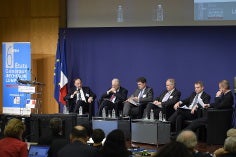
Paris, France. With seven panel discussions in a day, the French standards setter (ANC – Authorité des Normes Comptables) 2016 symposium was a packed event bringing together around 200 delegates from France but also the USA, the EU, Asia and Africa.

Access deeper industry intelligence
Experience unmatched clarity with a single platform that combines unique data, AI, and human expertise.
This was the first time the symposium had an international flavour due to a pure hazard of the calendar; with a few international meetings scheduled in the days around the French symposium, ANC president Patrick de Cambourg suggested to his international colleagues that they move their meetings to Paris and join in the symposium.
Focused on “performance and accounting” the symposium brought together the academics and the professionals. All the panels were introduced by a scholar presenting an academic paper around the question of performance and accounting before being joined on stage by a couple of professionals to discuss the topic. Equally all panels were concluded by a ‘key witness’, usually an international professional who linked the discussion to international issues.
De Cambourg concluded the day by saying that in the world of standard-setting there were a number of solid foundations, but also a number of uncertainties which needed to be built upon to help accounting progress, and to do so in the interest of the public.
He then summarised some of the key points that came out of the day-long debate noting that there seemed to be a consensus among speakers to have greater efforts on measuring the performance of companies. “However this effort seems to need to be empirical,” he added. “As I didn’t hear anywhere a global vision of performance measurement.”
While both the International Accounting Standards Board (IASB) and the Financial Accounting Standards Board (FASB) said they had planned projects to look at the question, De Cambourg noted that this would be done with a lot of prudence and that some might argue that those projects will be focusing on non-core topics.
Lack of a definition of performance
Throughout the debates it became apparent that a lack of definition of performance in the actual standards had led to the creation of alternative initiatives which now tend to take centre stage without linking up with the already standardised information, De Cambourg continued.
“Standard-setters need to face the challenge,” he said. “The objective of these initiatives is to describe better the reality of a company, but the risk is that we will have a lack of comparability and a vision of the company’s performance which will be too optimistic.”
Some speakers argued that this situation need to be tackled through regulation, while others preferred a market-led type of solution.
Plurality of users
Inevitably the debates tackle the current trend of an expanding audience of financial statements and the impact on standards.
“To be common the accounting language needs to address the plurality of the end-users and not only the investors,” De Cambourg concluded.
The question raised was whether by addressing the investors’ needs, accounting wouldn’t cater at the same time for other stakeholders’ needs. This wasn’t self-evident according to De Cambourg and he added that there was a real risk that other stakeholders would look elsewhere if the information provided did not answer their needs.
“Investors themselves admit that companies can be weakened if they don’t broaden their spectrum of performance indicators, be it financial or non-financial, to respond to the diversity in stakeholders,” he said.
Non-financial information
Also debated at the symposium was the growing number of initiatives for companies to report on non-financial information.
While De Cambourg admitted that this trend was irreversible, especially when it came to information linked to environmental issues, he said that the standard-setting in this area was still at an experimental stage and that the few rules which exist are limited to some countries or geographical zones.
“The connection between these non-financial elements and accounting remains a topic,” he said cryptically.
The public interest
The day ended with a round table discussion on ‘performance and the European public interest’ with a notably international panel, made up of: De Cambourg, Jean Paul Gauzes president of EFRAG, Hans Hoogervorst president of IASB, Erik Nooteboom from the EU Commission, and Benoit de Juvigny general secretary of the AMF.
A few gentle gibes were exchanged among the panel which prombted De Cambourg to say in his conclusion that the European diversity is a true richness “on the condition that we don’t believe everything we have done is always good”.
“We have to be careful in a current environment where sovereignty is expressed strongly,” he continued. “We shouldn’t say to the public that by definition technicians are right. We have to acknowledge the fears and anxiety that some might have and in particular those of the companies.”